Introduction
Sitting at a desk for hours can leave you feeling inactive. Whether you work from home or live in a small apartment, compact fitness equipment can help you stay active without taking up much space.
Two popular options are a mini exercise cycle and a mini elliptical trainer. Both allow you to exercise your legs while seated, but they differ in pedal motion, design, and space requirements.
Understanding these differences will help you choose the right equipment for your daily routine.
1. What Is a Mini Exercise Cycle?
A mini exercise cycle, also called a pedal exerciser or mini pedal exerciser, features a compact, low-profile design built around a familiar movement. It uses a circular, revolving pedalling motion that mimics a standard bicycle or a traditional stationary bike.
Your feet travel in a complete, fixed circular path as the pedals rotate. With its small footprint, a mini exercise cycle is a popular choice for users who want a straightforward, budget-friendly way to add movement while watching television or sitting at a table.
2. What Is a Mini Elliptical Trainer?
A mini elliptical trainer takes a different mechanical approach to seated or compact workouts. Instead of a circular rotation, it utilises a gliding, oval-shaped motion that moves forward, backwards, slightly up, and down.
This movement pattern closely resembles a natural walking or jogging stride. Typically equipped with larger footplates, a mini elliptical trainer supports your feet throughout the entire gliding motion, offering an alternative movement style for individuals seeking a smooth, non-circular trajectory.
3. Mini Elliptical Trainer vs. Mini Exercise Cycle: Key Differences
To better understand how these two compact machines compare, it helps to examine their core operating characteristics side by side.
|
Feature |
Mini Exercise Cycle (Pedal Bike) |
Mini Elliptical Trainer |
|
Pedal Path |
Circular (rotating like a bike) |
Oval/Gliding (walking or jogging stride) |
|
Foot & Leg Movement |
Feet follow a fixed circular rotation with straps |
Feet remain supported on footplates during an oval glide |
|
Knee Motion |
Full circular rotation where knees bend and continuously lift |
Flat-footed gliding stride with less vertical knee travel |
|
Under-Desk Clearance |
Higher clearance required due to the upward circular arc |
Lower clearance needed as feet glide closer to the floor |
|
Typical Exercise Focus |
Lower-body cycling or optional hand pedalling |
Lower-body gliding focused on legs, glutes, and core |
|
Versatility |
Easily placed on a stable surface for upper-body arm workouts (if permitted) |
Generally restricted to lower-body use via footplates |
|
Important Considerations |
Check desk height and knee clearance before use |
Verify device height and stride length against available space |
4. Understanding the Main Difference
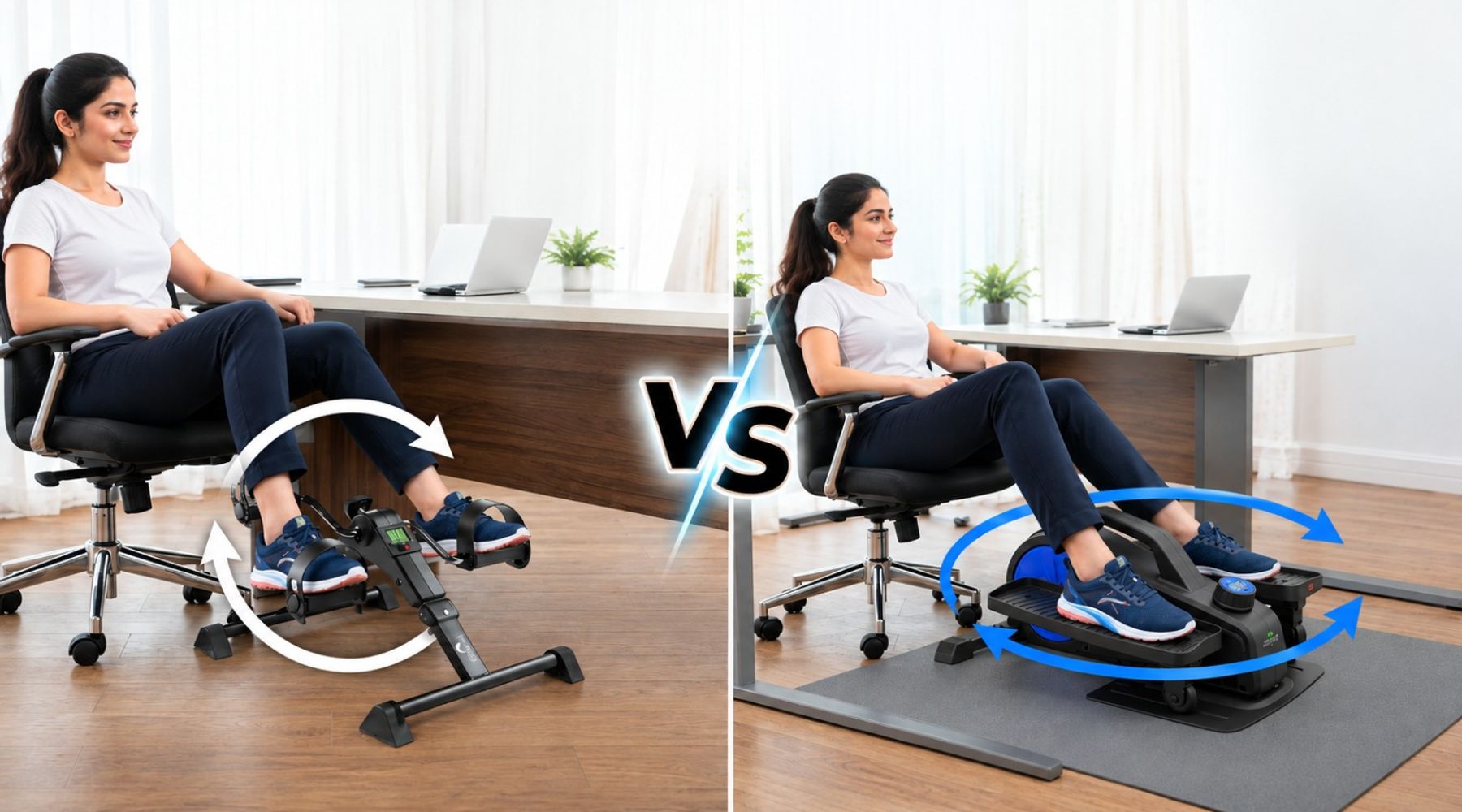
The biggest difference is the pedal path. A mini exercise cycle moves your feet in a circular motion, causing your knees to rise with every rotation. A mini elliptical trainer uses a flatter, oval-shaped gliding motion that can keep your feet closer to the floor.
This difference affects how much space you need beneath your desk and which movement feels more comfortable for your routine.
5. Which Is Better for Under-Desk Exercise?
Before using either device under a desk, consider your desk height, chair position, leg length, and available space.
A mini exercise cycle may require more vertical clearance because its circular pedal motion raises your knees. Without enough space, your knees could hit the underside of the desk.
Many seated mini elliptical trainers have a flatter pedal path, which may make them easier to use under a desk. However, suitability depends on the individual product's dimensions and your seating position.
Tip: Measure your available space before buying either device.
6. Can a Mini Exercise Cycle Help With Weight Loss?
Using a mini exercise cycle for weight loss can help increase your daily physical activity and calorie expenditure.
However, weight loss depends on several factors, including exercise consistency, overall activity, nutrition, and individual metabolism. A mini exercise cycle can support your fitness routine, but it works best as part of a balanced, healthy lifestyle rather than as a standalone weight-loss solution.
7. What Should You Consider Before Buying?
Keep these factors in mind when choosing compact fitness equipment for your home or office:
- Available Space: Check whether the machine fits your floor area and storage space.
- Desk Height and Clearance: Make sure your knees can move freely during exercise.
- Pedal Motion: Choose between circular cycling and oval-shaped gliding.
- Resistance Settings: Consider adjustable resistance for different workout intensities.
- Stability and Build: Look for a sturdy frame, a non-slip base, and suitable anchoring features.
- Upper-Body Use: If you want to pedal with your hands, verify that the mini cycle is specifically designed for safe tabletop use.
- Budget and Features: A mini exercise cycle price can vary depending on build quality, resistance mechanisms, digital displays, and brand features. Compare models based on the features you actually need.
8. Mini Elliptical Trainer or Mini Exercise Cycle: Which Should You Choose?
The right choice depends on your space, preferences, and exercise goals.
Choose a mini exercise cycle if you prefer traditional circular pedalling and want a compact device that may also support hand exercise when designed for tabletop use.
Choose a mini elliptical trainer if you prefer a gliding stride that generally keeps your feet closer to the floor. This design may be more suitable for under-desk use when vertical clearance is limited.
Before making a decision, compare the pedal motion, product dimensions, and available legroom to find the best fit for your routine.
Frequently Asked Questions
1. What is the difference between a mini elliptical and a mini exercise cycle?
A mini exercise cycle uses circular, bicycle-like pedalling, while a mini elliptical trainer uses an oval-shaped gliding motion similar to walking.
2. Is a mini exercise cycle suitable for home workouts?
Yes. Its compact design makes it convenient for light exercise at home, and it can usually be stored easily when not in use.
3. Can a mini exercise cycle be used under a desk?
Yes, provided there is enough space for your knees to move freely. Its circular pedal motion may require more vertical clearance than a mini elliptical trainer.
4. Can a mini exercise cycle help with weight loss?
It can support daily physical activity and calorie expenditure when used consistently. Results also depend on nutrition, lifestyle, and overall activity levels.
5. What affects the price of a mini exercise cycle?
The price depends on factors such as materials, build quality, resistance mechanisms, digital displays, and brand features.
Conclusion
Choosing between a mini elliptical trainer and a mini exercise cycle comes down to pedal motion, available space, and personal preference. A mini exercise cycle offers familiar circular pedalling, while a mini elliptical trainer provides a gliding movement that may require less vertical clearance.
Explore our Mini Elliptical & Mini Exercise Cycle to find compact fitness equipment that fits your space, daily routine, and workout goals.